
 TR
TR
 EN
EN
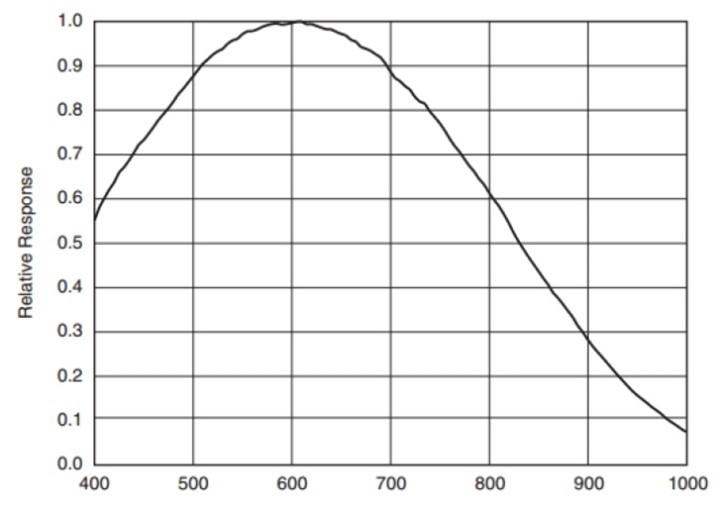
Human eye can perceive wavelengths between 400nm and 700nm. CCD cameras, however, can perceive wavelengths up to 1000nm. Infrared illuminators emit light in the infrared region which is outside the human eye perception limits but inside the perception limits of CCD cameras.
In this way, while the human eye cannot see anything in absolute darkness illuminated by an infrared illuminator, every detail is clearly visible in the image captured by the CCD camera.
Human eye can perceive wavelengths from 400nm to 700nm. The region beyond red is called the infrared (IR) region.
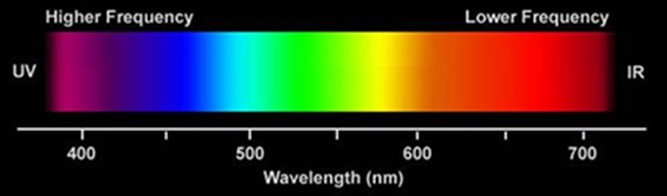
Human Eye — CCD Camera Perception Graph

Color cameras cannot perceive infrared because an "infrared cut filter" is placed in front of their sensors to ensure accurate color reproduction. This filter blocks infrared light entirely.
Day/Night cameras provide color images during the day and automatically remove this filter when the light level drops, switching to infrared-sensitive monochrome mode at night. This feature is called ICR (Infrared Cutfilter Removal).
Some basic CCTV cameras are manufactured without an infrared cut filter, making them infrared-sensitive by default.
Universal has been importing infrared illuminators from the United Kingdom and Italy since 1993 and has been using them extensively for night vision applications. Since 1999, Universal has been designing and manufacturing its own infrared illuminators using semiconductor (LED) technology.
The UNI 100, UNI 200 and Mini Robust models introduced to the market in 2010 feature the highest specifications available on the world market and have been designed and manufactured to operate safely and reliably under the most demanding conditions.
- IP 68 — Highest rating for dust and water resistance
- IK10+ — Highest rating for impact resistance
- EMC (ElectroMagnetic Compatibility) — Compliant with all relevant directives
- UV resistant
- SOLID AND PURE ALUMINIUM HOUSING — Extremely high natural heat dissipation capacity, far superior infrared output and very long service life compared to competitors
- Stainless steel accessories
- 850nm and 940nm wavelength options
- Very high infrared output at very low power consumption
- Available in 220V AC, 48V DC and 24V DC versions
- Automatic day/night operation via photocell switch
- 20+ years projected service life
- 5 (FIVE) YEAR manufacturer's warranty (fixed installations)
- Quality certificates from independent accredited bodies
- MIL-STD 461F option available
- Day/night synchronisation with camera
All of the above specifications have been certified by independent accredited institutions. For example, the IK10 test involves a 5kg metal weight being guided through a tube and dropped vertically onto the device three times. This test was carried out in TSE laboratories.
Thanks to the specially designed solid and pure aluminium housing, infrared output is extremely high, remains consistent regardless of seasonal temperature variations, and the device has a very long service life (20+ years).
The crystal clear and homogeneous night vision it delivers enables cameras to make full use of AI-based features such as "motion detection", making the facility significantly more secure.
We have many different models available. We can offer you the most suitable options based on your specific application requirements.
Our devices are used with great satisfaction in very special military applications under the most demanding conditions. These applications are not published on our website and are shared only with the relevant military authorities.
Thermal cameras produce a kind of heat map, showing objects in a scene based on temperature differences. It is not possible to identify persons from images taken by this method. Furthermore, many details cannot be seen — for example, road lane markings or facial features such as eyebrows and eyes.
With infrared illuminator-based night vision, every detail in the scene is clearly visible in monochrome (black and white), and persons can be positively identified.
An EX-PROOF version of our Mini Robust model is available. It can be used in explosive atmospheres classified as Zone-2 as defined by the ATEX certificate.
Just one of the many problems: Spiders attracted by the camera's built-in IR LEDs spin webs directly in front of the lens, causing spider webs to appear in the image and trigger FALSE ALARMS. This prevents the camera from making use of its intelligent features and weakens overall site security.
The only solution to this problem is to use a SEPARATE INFRARED ILLUMINATOR away from the camera. When Universal infrared illuminators are used, false motion alarms are eliminated, and the wide-angle, homogeneous and powerful illumination ensures crystal clear night vision images.
We thank Mr. Halil Yıldız for this video.
Infrared illumination is also necessary indoors to capture any undesired events that may occur at night. In particular, venues such as museums, banks, supermarkets, warehouses and factories require infrared illumination to achieve clear, homogeneous images even in absolute darkness.
For such applications, our Micro Indoor model is highly effective with its unique compact and aesthetically pleasing design. Achieving similar image clarity with LED-equipped cameras is generally not possible.
When a bright visible light source is directed at the human eye, the iris instantly contracts and the eyelid closes as a reflex protective response. However, since the human eye cannot perceive infrared light, no such reflex response occurs.
Especially in dark environments where the iris is fully open, if an extremely intense infrared beam enters the eye at close range, permanent damage to the eye may occur. Technicians performing installations must therefore never look directly at an operating illuminator at close range without taking appropriate precautions.
For this reason, Universal illuminators bear a prominent "Warning — Hazardous Radiation to Eyes" label on their front face. This risk applies to all infrared illuminators regardless of brand. Universal is the only manufacturer in the world to clearly display this warning on the front face of the device.
Yes. A major benefit is the prevention of light pollution. In addition, infrared illuminators used in traffic areas are far safer from a road safety perspective. Visible light projectors aimed at traffic areas can cause glare for drivers, endangering road safety.
Furthermore, Universal infrared illuminators are environmentally friendly due to their very low energy consumption, which also contributes to a shorter payback period.
Yes. The clear, homogeneous and consistent night illumination provided by Universal infrared illuminators produces images that occupy less storage space on the hard drive, allowing longer recording periods.
Poorly illuminated, noisy and unclear night images consume significantly more hard drive space, which reduces the total recording duration.
- All types of security surveillance
- License plate recognition, driver identification
- City surveillance (CCTV) and smart city systems
- Interior illumination of cash-in-transit vehicles
- Vehicle headlights for night driving
- Wildlife observation at night
- Fish farms, marine vessels
- Railways, under-vehicle inspection
- Wind and solar energy plants
- Machine vision (object counting, people counting, reading, analysis)
The presence of glaring light sources within the camera's field of view can cause the camera iris to close, reducing the effective range. Additionally, highly reflective objects at close range — such as nearby tree branches — may cause infrared light to bounce back towards the camera, degrading image quality.
By adjusting the camera angle to avoid such scenes as much as possible, a longer night vision range can be achieved.
850nm wavelength provides more effective night vision because CCD cameras are more sensitive at this wavelength. The only drawback is a faint reddish glow that may be noticed on the illuminator's glass surface. Since this is not a concern in applications such as traffic monitoring, city surveillance, CCTV and license plate recognition, 850nm is preferred in these systems for its superior efficiency.
When a completely covert night vision illumination is required, a 940nm infrared illuminator is used. Illumination at this wavelength is completely invisible to the naked eye.
Wavelength (nm = nanometres)
As the angle widens, a larger area is covered but the effective range decreases. As the angle narrows, longer range night vision can be achieved.
Standard radiation angles are 20°, 45°, 60°, 90° and 120°.
The angle closest to the camera's field of view angle should be selected.
Terms Used for These Products